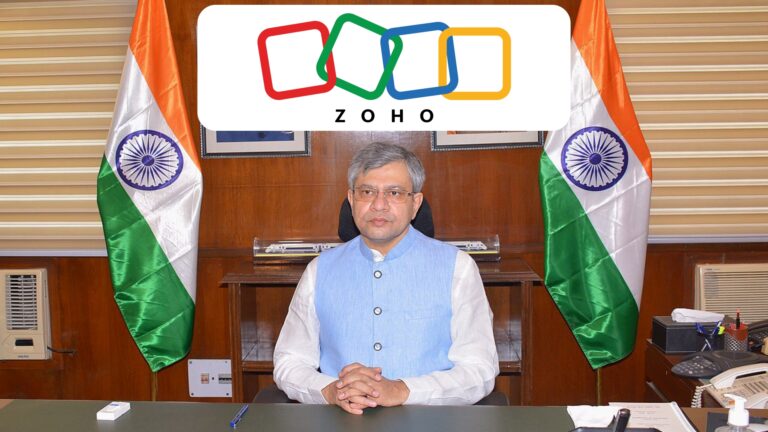
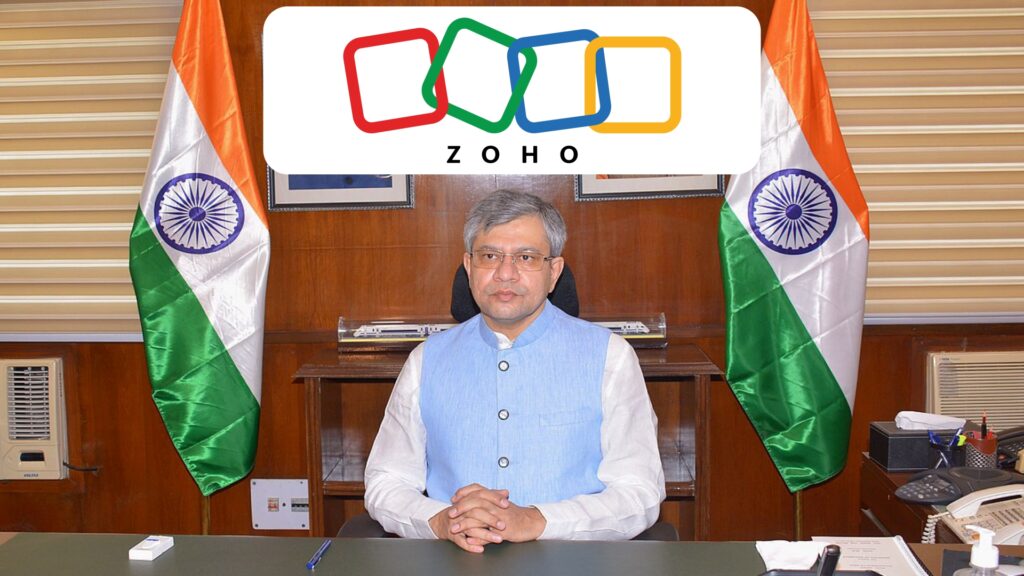
In a bold move that has sparked nationwide discussion, Union Minister Ashwini Vaishnaw recently announced that he will stop using Microsoft and Google products for his daily work. Instead, he has switched to the Zoho which is a Swadeshi productivity platform – a homegrown Indian alternative for documents, spreadsheets, and presentations.
This announcement is much more than a personal choice. It represents India’s push for Aatmanirbhar Bharat (self-reliant India) and its commitment to promoting indigenous technology. Zoho, built in India and trusted worldwide, is suddenly at the center of the debate: Can it truly replace tech giants? And why is this change so important right now?

What Is Zoho?
Zoho is an Indian SaaS (Software as a Service) company founded in 1996 by Sridhar Vembu and Tony Thomas. What began as a small venture called AdventNet has now grown into a global powerhouse with more than 55 cloud-based apps. These include:
Zoho Writer (documents)
Zoho Sheet (spreadsheets)
Zoho Show (presentations)
Zoho Mail (email)
Zoho WorkDrive (storage)
Zoho CRM, Zoho Books, Zoho People and many more business solutions
Today, Zoho serves over 100 million users in 150+ countries, but what makes it special is that much of its development is done in Indian towns and rural areas like Tenkasi, Tamil Nadu. Unlike global giants, Zoho runs on a philosophy of affordability, privacy, and independence from advertising.
This is why Vaishnaw’s endorsement of the Zoho Swadeshi productivity platform feels both practical and symbolic.
Why Did Ashwini Vaishnaw Switch to Zoho?
On September 22, 2025, Ashwini Vaishnaw announced on social media that he had migrated to Zoho for his documents, spreadsheets, and presentations. His message was simple but powerful: support Indian technology, adopt Swadeshi products, and reduce dependency on foreign platforms.
This move comes at a time when India is negotiating global trade deals and emphasizing technology sovereignty. By shifting to the Zoho Swadeshi productivity platform, Vaishnaw sent three clear signals:
Symbolism – If a top IT minister can use Zoho, so can every Indian citizen and business.
Trust in Indian Products – It shows that Indian-built technology is ready to compete with global giants.
Policy Direction – It hints that government departments may soon prioritize indigenous platforms.
Zoho’s founder Sridhar Vembu responded by calling this switch a “huge morale boost” for his engineering teams.
Features of Zoho Swadeshi Productivity Platform
Zoho isn’t just a patriotic choice – it’s a capable suite that offers what most users need. Here’s what stands out:
Comprehensive Productivity Tools: Writer, Sheet, and Show allow users to create documents, analyze data, and design presentations. While not identical to Microsoft Office or Google Workspace, they cover most daily requirements.
Collaboration & Communication: With Zoho Mail, Zoho Meeting, and Zoho Cliq (chat), teams can work together in real-time. This makes the Zoho Swadeshi productivity platform a complete package.
Privacy First: Unlike Google, Zoho doesn’t rely on advertising models. Its focus on user privacy and data protection resonates with today’s concerns about sovereignty and digital security.
Affordable Pricing: Zoho is often cheaper than Microsoft 365 and Google Workspace. For small and medium businesses, this cost advantage can be significant.
Integrated Ecosystem: Beyond productivity apps, Zoho offers CRM, accounting, HR, and project management – making it an all-in-one platform.
How Zoho Compares to Microsoft and Google
When people think of productivity, they immediately think of Microsoft Office 365 and Google Workspace. So how does the Zoho Swadeshi productivity platform measure up?
Ease of Use: While Microsoft remains the gold standard for complex business tools, Zoho covers the essentials at a fraction of the cost. Google focuses on cloud-first, while Zoho balances offline and online usage.
Privacy and Control: Unlike Google, Zoho doesn’t mine user data for ads. This makes it an attractive choice for governments and businesses that need secure data handling.
Affordability: Microsoft and Google often charge premium prices, especially for enterprise-level features. Zoho gives small businesses and startups powerful tools at accessible rates.
Integration: Microsoft dominates in enterprise ecosystems, and Google is unbeatable in collaboration. But Zoho offers something unique – a single, integrated suite covering not just productivity but CRM, HR, finance, and analytics.
This makes Zoho not just a replacement, but a potentially better holistic platform.
The Swadeshi Push: Why Zoho Matters for India
Vaishnaw’s shift to Zoho isn’t just about using an Indian product. It’s about building confidence in India’s Swadeshi tech movement.
Economic Impact: The more Indians adopt Zoho, the less money flows to foreign software monopolies. This strengthens the domestic tech economy.
Job Creation: Zoho already employs thousands in rural India. Greater adoption means more employment opportunities across small towns.
Data Sovereignty: With sensitive government and business data stored within Indian infrastructure, risks of dependency on foreign companies reduce.
Global Recognition: Zoho has already proven itself internationally. With government adoption, its stature as a global Indian brand will grow further.
The Zoho Swadeshi productivity platform thus becomes more than just software. It becomes a symbol of India’s self-reliance in the digital age.
Challenges for Zoho
No product is without challenges. For Zoho, the road ahead involves:
Compatibility Issues: Many Indian companies are already locked into Microsoft or Google ecosystems. Transitioning may cause friction.
Feature Gaps: Power users of Excel macros or Google App scripts may find limitations.
User Habits: People are comfortable with Gmail or Word. Changing habits requires strong training and awareness campaigns.
Enterprise Adoption: Convincing very large corporations to shift will take time and proof of long-term stability.
Despite these hurdles, the momentum created by the IT minister’s decision gives Zoho an unprecedented advantage.
Zoho and the Future of Indian Tech
Zoho’s rise proves that Swadeshi innovation can compete globally. It also shows that India can build privacy-first, affordable, and scalable technology.
The company is already experimenting with AI-driven features like Zoho Zia, an intelligent assistant that summarizes documents, analyzes spreadsheets, and automates tasks. By embedding AI in its productivity tools, the Zoho Swadeshi productivity platform could leapfrog competitors in emerging markets.
This makes it not only a replacement for Microsoft and Google but a leader in the future of productivity.
Conclusion
Ashwini Vaishnaw’s switch to the Zoho Swadeshi productivity platform is both a symbolic and practical step. Symbolic because it reflects India’s growing confidence in its homegrown innovations, and practical because Zoho truly delivers on features, privacy, and affordability.
For India, this isn’t just about one minister’s choice. It’s about encouraging millions of businesses, students, and professionals to adopt indigenous technology. It’s about showing the world that Indian products can compete with – and sometimes surpass – the best.
The future of India’s digital independence may very well rest on platforms like Zoho. And if the government leads the way, citizens and companies are likely to follow.
For more detailed guides on technology, check out the ReadIvy Technology section.
Explore more topics across finance, AI, travel, and entertainment at ReadIvy.